First planet · 0.39 au from the Sun
Mercury
The smallest planet, and the one nearest the Sun. It has almost no air, so nothing softens the light. Keep scrolling and you will land near its north pole, where the Sun barely gets off the horizon.
A day longer than a year
Mercury goes round the Sun in 88 days and turns on its axis once every 59. The two fit together so that it turns exactly three times for every two trips round the Sun. Put them together and one sunrise to the next takes 176 days, two whole Mercury years.
Its orbit is the most stretched of any planet. At the closest point the Sun looks more than three times as wide as it does from Earth. From some places on the surface the Sun rises, stops, slips back a little, then carries on.
Mostly iron
Mercury is only a little bigger than our Moon, but it is far heavier for its size. Its iron core reaches out to about 85 per cent of the way to the surface, which leaves a thin shell of rock on top. Nobody is sure why. One idea is that a huge collision early on stripped most of the rock away.
That core still makes a weak magnetic field, about one per cent as strong as Earth’s.
No sky to speak of
Without air there is nothing to scatter sunlight, so the sky stays black even with the Sun up. Shadows are black too. There is no blue haze on the hills, so the far rim of this crater, twelve kilometres away, looks as sharp as the rocks at your feet.
The Sun here is two and a half times as wide as from home. Mercury’s axis is almost exactly upright, so near the poles the Sun just circles round the horizon and never climbs far.
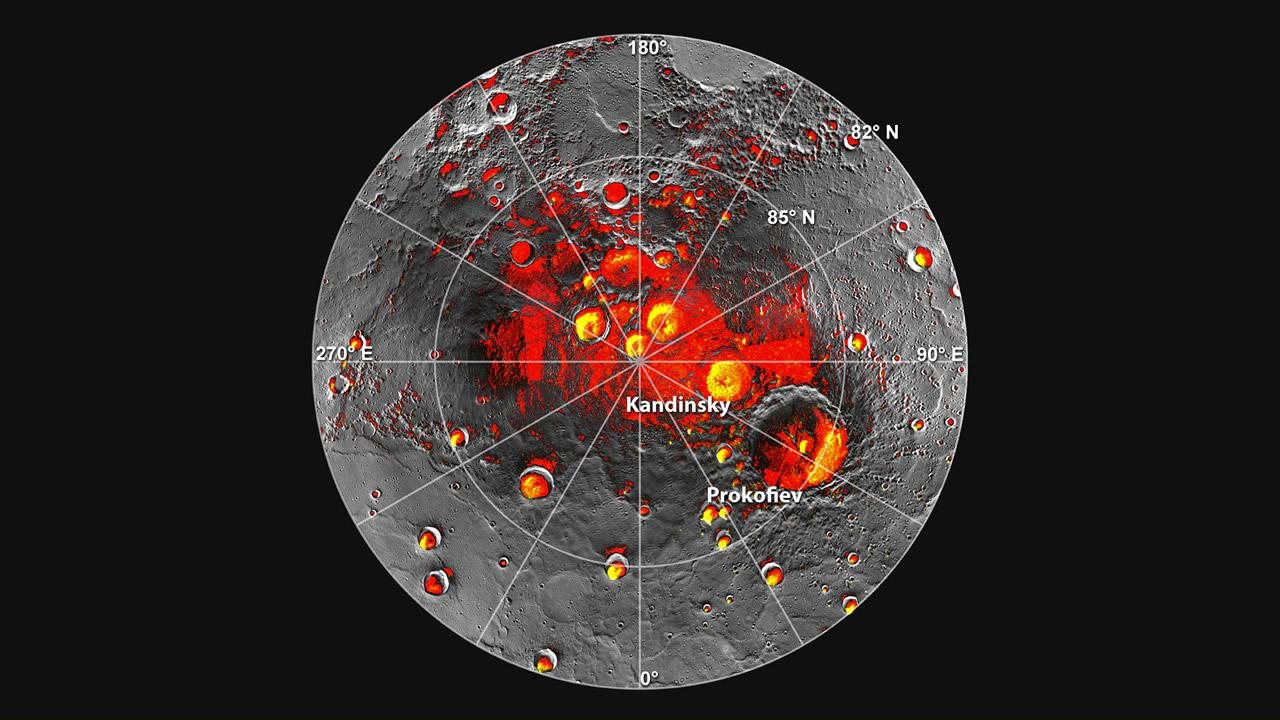
Ice, on the planet next to the Sun
The floors of many polar craters never see the Sun at all, not for a moment, and they stay at around −170 °C or colder. In 1991 radar from Earth picked up something bright inside them. MESSENGER, which orbited Mercury from 2011 to 2015, confirmed in 2012 that it is water ice.
Wrinkled as it shrank
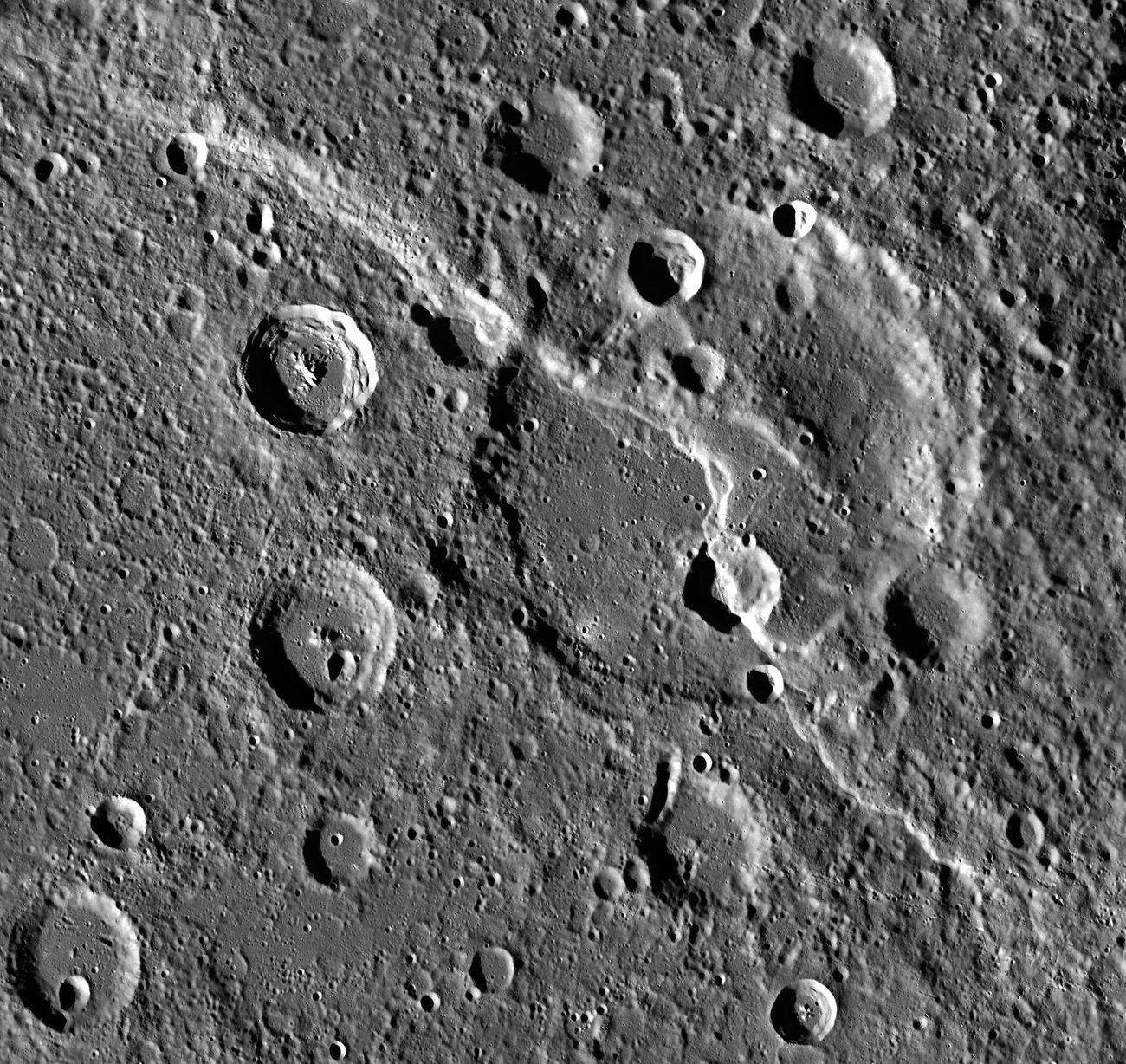
As the inside of Mercury cooled, the whole planet contracted. Its radius has shrunk by as much as seven kilometres. The crust had to go somewhere. It pushed up into long cliffs, some of them hundreds of kilometres long and more than a kilometre high. There is one beyond the far side of the crater.
In numbers
- Radius
- 2,440 km
- Mass
- 0.3301 × 10²⁴ kg
- Gravity at the surface
- 3.7 m/s²
- Distance from the Sun
- 0.3871 au
- A year
- 88 days
- One turn on its axis
- 58.6 days
- Sunrise to sunrise
- 176 days
- Day and night
- 430 °C and −180 °C
- Moons
- 0
NASA NSSDC Mercury Fact Sheet and JPL orbital elements. Only two spacecraft have visited so far, Mariner 10 in 1974 and 1975 and MESSENGER. BepiColombo, from Europe and Japan, is on its way into orbit.
The ground here is generated, modelled on MESSENGER’s maps of the north polar region: a 12 km crater at about 79° north, older craters at every size, and a lobate scarp beyond its far rim. The Sun is drawn at its true average size.